Financial & Market Modeling – Cost per location investments, NPV analysis, and deployment ROI.
Coverage, Competition, Market Insights – Provider footprints, service levels, demographics, and federally funded areas.
Data That Shapes Policy – Data trusted and used by the FCC, NTIA, and infrastructure planners.
The Broadband Fabric NetworkPlan Data Suite provides in-depth cost modeling, network planning, market, and deployment insights, equipping stakeholders with reliable data to use as financial benchmarks and create strategic and profitable expansion models for projects.
Built on CostQuest’s Location and ServiceLandscape Datasets, this suite delivers broadband service availability at the address level, investment modeling that provides deployment costs for modern fiber and fixed wireless builds, engineering variables, economic feasibility, and demand indicators that help determine adoption and expansion potential.
Trusted by broadband providers, policymakers, consultants, and engineers, this Dataset streamlines infrastructure roll-outs that yield a positive ROI and optimizes network investment planning. Data is available for all U.S. counties, states, and territories.

Sample Data
Most comprehensive Data provided for review.
View sample Data
Data delivered via .CSV file or GeoPackage (.gpkg) for easy integration into business systems.
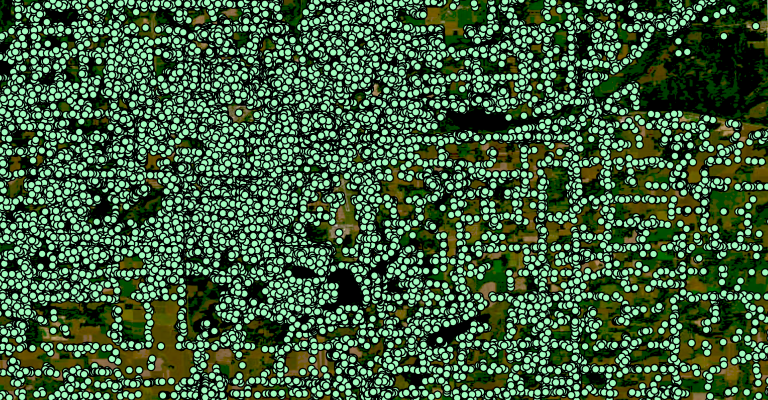
A zoomed-out GIS visualization of the Fabric NetworkPlan Data. Once the data is manipulated and formatted in the GIS, the colored dots can represent each structure’s exact location, and it’s cost investment to serve, ranging from low to high cost to serve locations.
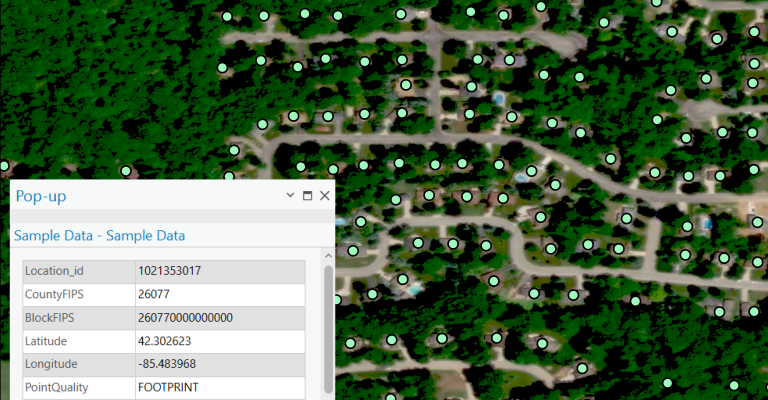
A zoomed-in GIS visualization of the Fabric NetworkPlan Data. Once the Data is manipulated and formatted in the GIS, users can click the green dots to view detailed coordinates, address, service availability status, providers reporting service, if federal funding has been allocated, name of funding program, name of funding recipient, the cost investment to serve a standard fiber and fixed wireless greenfield deployment for each location.
13 Data Categories Included
Broadband Serviceable Locations
Identifies all location structures where broadband service is or can be installed, including federally defined Broadband Serviceable Locations.
Includes coordinates, addresses, unique IDs, building types, unit counts, and land use classifications.
Differentiates Active Locations (all broadband-eligible structures) and Federally Defined BSLs (meeting federal serviceability standards).
*Source: CostQuest Custom Model
BDC Service Availability and Carrier Summary
Tracks broadband availability, provider coverage, technology, and service levels at each Broadband Serviceable Location.
Lists providers name and technology type (Fiber, Fixed Wireless, Cable, etc.)
Categorizes locations per FCC criteria, with broadband speeds from Served (access to ≥100/20 Mbps), Underserved (access to 25/3 Mbps minimum - 100/20 Mbps maximum), to Unserved (access below <25/3 Mbps).
Categorizes locations per NTIA criteria, with Served (access to low-latency Fiber, Cable, Copper, or Licensed Terrestrial Fixed Wireless offering of speeds ≥100/20 Mbps), Underserved (access to 25/3 Mbps minimum - 100/20 Mbps maximum), and Unserved (without any Terrestrial Broadband Service or with internet service offering speeds below 25/3 Mbps or latency less than or equal to 100 milliseconds.)
*Source: FCC National Broadband Map
Federally Funded
Identifies Broadband Serviceable Locations that have received federal broadband funding.
Includes funding program details and award recipients.
Tracks major initiatives such as RDOF, CAF, EACAM, etc. and eventually BEAD.
*Source: FCC Broadband Funding Map
Broadband Funding Map Coverage
Indicates whether a location that falls under an existing federal funding program is covered or uncovered with funding, and with residential or business services using licensed fixed wireless or wired technologies (i.e., Copper, Cable, Fiber to the Premises, Licensed Fixed Wireless, or Licensed-by-Rule Fixed Wireless) with speeds of at least 25/3 Mbps or 100/20 Mbps.
U indicates opportunity = A location does not have access to speed tier.
Uncovered = No access to speed tier listed
Covered = Access to a speed tier listed
*Sourced from the FCC Broadband Funding Map
Fiber Cost Model
Typical Fiber-to-the-Premises (FTTP) greenfield and brownfield deployment costs and business case, including infrastructure investment, and long-term financial impact.
Access Investment - Provides investment to acquire, engineer and install a fiber access network per location.
Success Based Investment - Captures investment for Optical Network Terminal (ONT) and drop at the Fabric Location. This is the investment associated with connecting a specific customer location to the fiber network. Also referred to as success based investment.
NPV - The Net Present Value of a 20-year cash flow accounting for revenue, operating expense (network specific, non-network specific, customer operations, bad debt, and general administration), capital expenses (income tax and replacement capex), and initial capex with discount rate of 8.5%. Fiber network design assumes a carrier agnostic network.
*Source: CostQuest Custom Model
Fixed Wireless Cost Model
Provides costs for a typical greenfield and brownfield fixed wireless deployment, including infrastructure investment, and long-term financial impact.
Access Investment - Provides investment to acquire, engineer, and install a Fixed Wireless broadband network per location.
Success Based Investment - Captures investment for Fixed Wireless materials and labor at the customer premises: router, antenna, cabling, etc. This is the investment associated with connecting a customer location to the fixed wireless network. Also referred to as success based investment.
NPV - The Net Present Value of a 20-year cash flow accounting for revenue, operating expense (network specific, non-network specific, customer operations, bad debt, and general administration), capital expenses (income tax and replacement capex), and initial capex with discount rate of 8.5%.
*Source: CostQuest Custom Model
5G Model
Ranks locations by relative cost of deploying 5G wireless broadband based on geographic and economic factors.
Assigns a cost index (1-100) based on regional deployment challenges.
As examples: a value of 10 means the location falls in an area that is in the lowest 10% of the country; a value of 75 means the location falls in an area where the cost is in the highest 75% range of the country.
*Source: CostQuest Custom Model
Take Rate
Estimates broadband adoption rates for new fiber providers based on market conditions.
Forecasts residential and business market share for new fiber entrants.
Considers factors like competition, infrastructure availability, and population density.
*Source: CostQuest Custom Model
Build Complexity Scoring
Assesses deployment difficulty for fiber networks based on environmental and infrastructure factors.
Evaluates terrain, population density, infrastructure proximity, and cost differentials.
Scores locations on complexity for Greenfield and Brownfield fiber builds.
*Source: CostQuest Custom Model
Building Statistics
Provides structural characteristics relevant for broadband planning and network design.
Includes building height, roof slope, and mean elevation above ground level.
Supports infrastructure deployment, network design, and permitting analysis.
*Source: CostQuest Custom Model
Natural Hazards
Identifies Broadband Serviceable Locations at risk of natural disasters that may affect infrastructure resilience.